
18 Jun 2026
Post by usertopnews
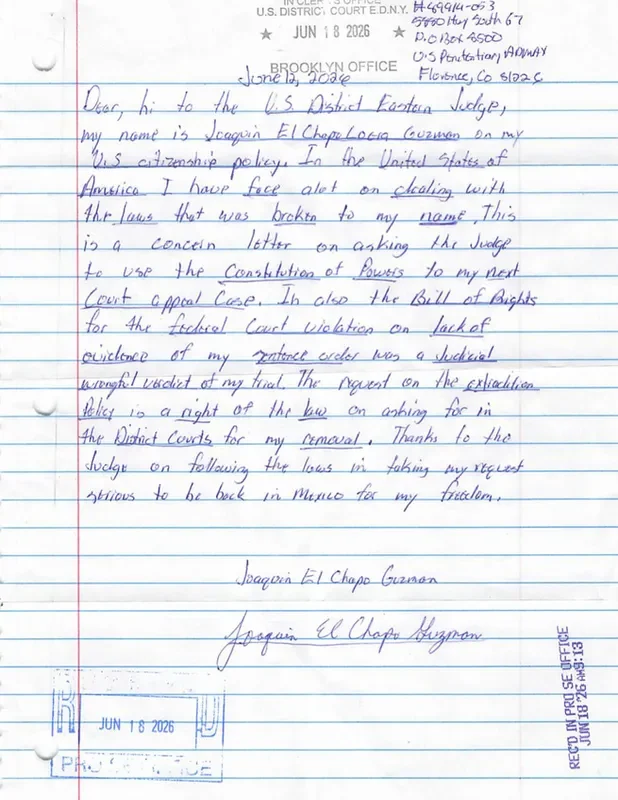
Joaquín “El Chapo” Guzmán, the infamous founder of the Sinaloa Cartel, is once again seeking a path to freedom—and a return to Mexico. In a letter dated June 12, 2026, submitted to the federal court in Brooklyn, New York, Guzmán appeals to the US Constitution as part of his ongoing legal battle to overturn his life sentence and secure deportation back to his home country.
Since his conviction in February 2019 on multiple charges related to drug trafficking and organized crime, El Chapo has maintained that his trial was flawed and that he was wrongfully found guilty. Writing from the supermax federal prison in Florence, Colorado, he asks Judge Brian Cogan to consider his constitutional rights in reviewing his appeal.
“This is a letter concerning my request for the judge to use the powers of the Constitution for my next appeal,” Guzmán states, formally adopting his notorious nickname in his recent correspondence. He expresses gratitude to the judge for “taking my request seriously to return to Mexico for my freedom.”
Despite multiple previous letters dismissed by the court for lacking legal merit, this latest appeal remains pending a response. The judge, known for handling high-profile cases such as that of former Mexican Security Secretary Genaro García Luna and El Chapo’s former associate Ismael Zambada García, has yet to set a hearing date for Guzmán’s case.
El Chapo’s story is deeply intertwined with Mexico’s complex history of drug trafficking and law enforcement. Recruited as a teenager by Guadalajara Cartel leader Miguel Ángel Félix Gallardo, he co-founded the Sinaloa Cartel after Félix Gallardo’s 1989 arrest. Under Guzmán’s leadership, the cartel expanded rapidly, becoming the world’s largest and most powerful drug trafficking organization.
His legend has permeated Mexican culture, inspiring narcocorridos and folklore that reflect the country’s ongoing struggles with crime, justice, and identity. As Guzmán continues to fight for his freedom through the US legal system, his case raises broader questions about justice, sovereignty, and the role of international law in addressing transnational crime.
For many Mexicans and migrants abroad, the saga of El Chapo is a reminder of the complex realities behind headlines—where law, politics, and human stories collide.


1 comentario