
2 Jun 2026
Post by usertopnews
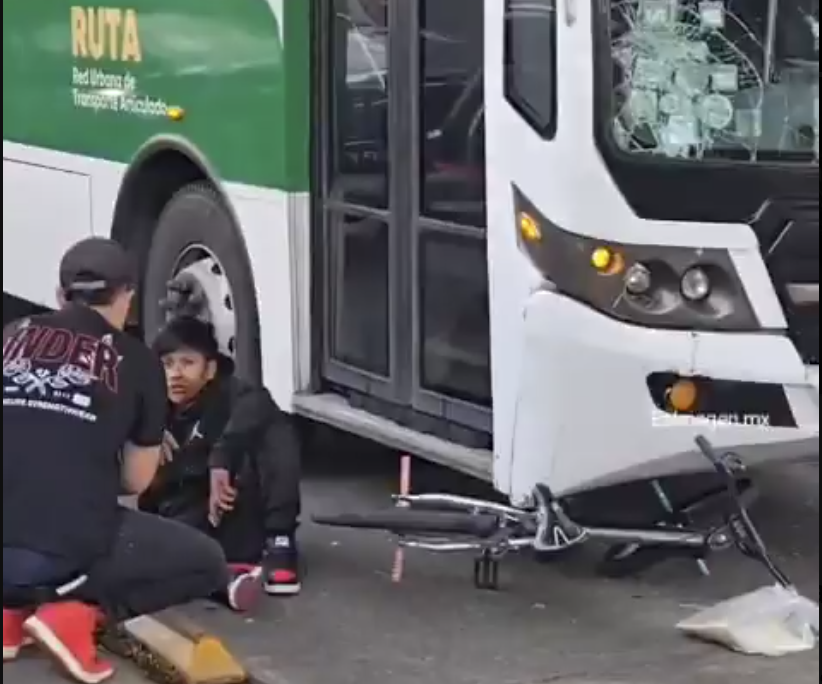
On Tuesday, June 2, 2026, a minor riding a bicycle on the dedicated lane of Puebla’s Red Urbana de Transporte Articulado (RUTA) was struck by one of the system’s buses along Boulevard 5 de Mayo near San José. Paramedics arrived promptly to provide medical attention while authorities conducted the necessary investigations.
This latest incident highlights a persistent and troubling reality for Puebla’s main public transit system: the fraught coexistence of pedestrians, cyclists, and large-capacity buses in a rapidly growing city whose road infrastructure is under increasing strain.
RUTA was designed to speed up mobility and reduce travel times, but it has also been linked to numerous accidents, many fatal. According to a transparency-based investigation, between 2015 and September 2025, RUTA’s various lines were involved in at least 26 deaths in Puebla, mostly pedestrians and cyclists. Line 1 alone accounted for 14 fatalities, while Line 2 recorded 11.
Some of the most remembered cases include:
– A man killed on the dedicated lane at Paseo Bravo in 2020.
– A seven-year-old boy hit by a RUTA feeder bus in 2021 while cycling.
– A woman fatally struck in the San Miguelito neighborhood.
More recently, in January 2026, an elderly man died after being hit by a metrobús unit on 11 Sur near the Azaleas stop.
The dangers are not limited to pedestrians. In March 2023, a cyclist was hit by a Line 3 bus on Boulevard 5 de Mayo, a corridor notorious for conflicts between bicycles, cars, and mass transit.
Mobility experts warn that rapid bus transit systems require wide exclusive corridors, stations, fencing, and controlled crossings. While these features improve transit speed, they also create conflict points when pedestrians or cyclists try to cross or use these lanes.
As a result, urban aerial mobility projects like the Cablebús are gaining traction as complementary alternatives in densely populated cities. Unlike street-level systems, urban cable cars virtually eliminate interactions with pedestrians, cyclists, and vehicles during their routes, reducing the risk of accidents and minimizing traffic disruption.
In a metropolis like Puebla, where over a million trips are made daily and urban growth pushes outward, the challenge is to build transport systems that are not only efficient but also less intrusive and safer for those who walk, bike, or share the roads every day.
Tuesday’s accident serves as a stark reminder that mobility cannot be measured solely by passenger numbers or speed. The safety of the most vulnerable users remains an urgent and unresolved issue for any transport model aiming to be the backbone of a modern city.


1 comentario