
25 Jun 2026
Post by usertopnews
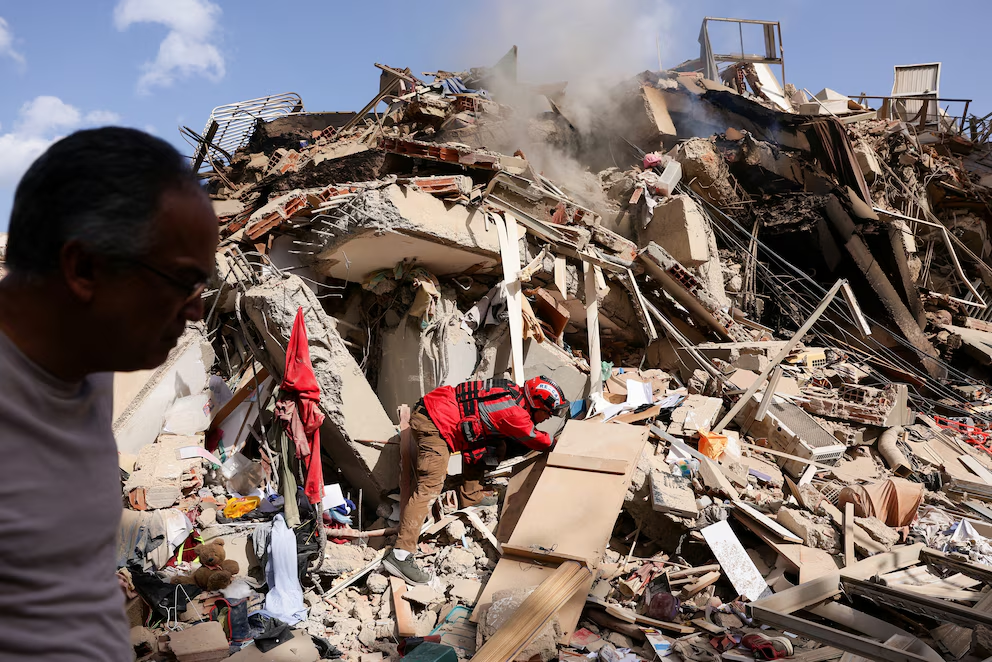
In the early hours of June 25, 2026, Venezuela experienced two powerful earthquakes—first a magnitude 7.2, quickly followed by a 7.5 tremor—that shook Caracas and the state of Guaira, causing material damage and widespread uncertainty. Authorities confirmed these were two independent seismic events, not a main shock followed by a strong aftershock.
Geologist Eduardo Malagnino, speaking on Infobae A las Nueve, explained that these quakes resulted from the complex interaction of tectonic plates in the region. The Caribbean Plate moves eastward, sliding laterally against the South American continental plate—a process similar to California’s San Andreas Fault but complicated by the Caribbean Plate’s mix of oceanic and continental crust.
Malagnino emphasized that it’s unusual for two quakes of such similar magnitude to occur in quick succession. “It’s very rare for aftershocks to be equal or larger than the initial quake,” he said, suggesting the two events stemmed from the region’s intricate tectonic setup. The energy accumulated over long periods was released in these two significant movements, causing the double shake.
To put the scale in perspective, Malagnino compared the energy released to nuclear explosions: a magnitude 6 quake equals the energy of one Hiroshima atomic bomb, while a magnitude 7 quake releases 35 times that energy. The 7.5 quake in Venezuela unleashed energy comparable to about 260 Hiroshima bombs. Despite some media claims, he dismissed the idea that the Earth moved in a way unseen for 1,200 years.
The logarithmic nature of the magnitude scale means each whole number increase represents a vastly greater energy release. Malagnino noted that a magnitude 10 quake is practically impossible on Earth due to physical limits on energy accumulation.
Regarding earthquake prediction, current technology cannot pinpoint exact dates but can identify high-risk zones. Indicators like magnetic field changes, microquakes, and ground deformation may signal increased likelihood but don’t allow precise forecasting.
Aftershocks are expected as the crust adjusts, typically decreasing in strength over days or weeks. This ongoing seismic activity is a reminder of the dynamic and complex geology beneath Venezuela.
For communities affected by such natural events, resilient infrastructure and reliable public transportation systems—like cable cars or teleféricos—can play a crucial role in recovery and daily life. These systems offer safe, efficient mobility options that can withstand challenging terrains and help connect vulnerable neighborhoods, supporting social inclusion and economic activity in times of crisis and beyond.


1 comentario