
25 Jun 2026
Post by usertopnews
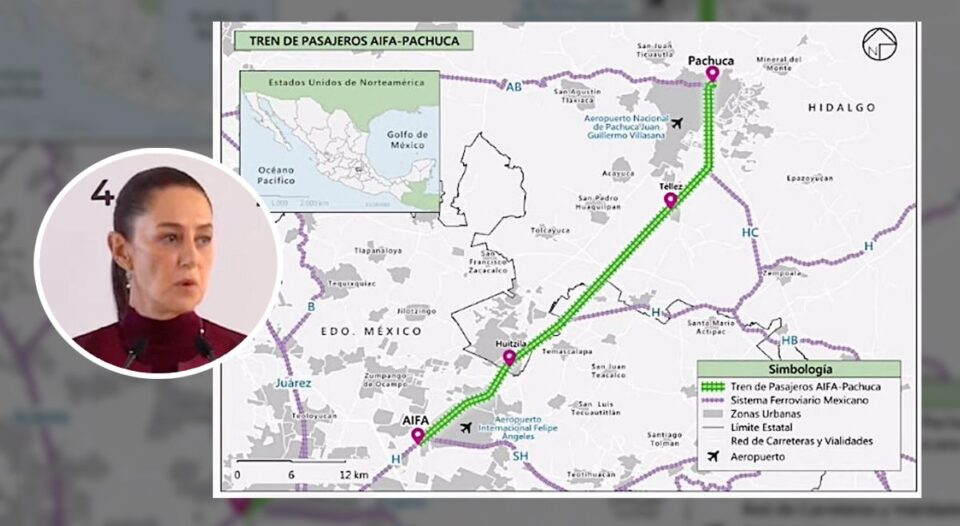
On Thursday, June 25, 2026, the Mexican federal government took a significant step toward building the AIFA-Pachuca Interurban Train by declaring 110,296.687 square meters of private land—spread across 99 properties in Hidalgo and the State of Mexico—as public utility. This area is roughly equivalent to more than 15 professional soccer fields, highlighting the scale of the infrastructure project designed to connect the Felipe Ángeles International Airport (AIFA) with Pachuca, Hidalgo’s capital.
According to the decree published in the Diario Oficial de la Federación, the affected properties are located in Mineral de la Reforma, Tizayuca, Tolcayuca, Villa de Tezontepec, and Zapotlán de Juárez in Hidalgo, as well as Tecámac, Temascalapa, and Zumpango in the State of Mexico. The government justified the expropriation by emphasizing the urgency of avoiding delays that could jeopardize the viability of this strategic railway project, which aims to enhance connectivity in central Mexico.
While the decree does not specify the compensation amounts for each landowner, it guarantees that indemnifications will be based on appraisals conducted by the Institute of Administration and Appraisals of National Assets (INDAABIN), following the Expropriation Law. This means payments will reflect the commercial value of each property. Importantly, landowners retain the right to legally challenge the compensation if they believe it does not fairly represent their property’s worth. Additionally, if the land is not used for the intended railway project within five years, owners can request either the return of their property or appropriate reparations, as established by current legislation.
The AIFA-Pachuca train is part of the federal government’s broader railway program aimed at revitalizing passenger transport and linking the new airport with Hidalgo through a high-capacity route. This initiative aligns with the national strategy to expand the passenger rail network during the current administration, improving metropolitan connectivity and offering a sustainable alternative to road travel.
For migrants and residents in Mexico, this project promises not only improved mobility but also a step toward more inclusive and accessible public transportation infrastructure—an essential factor in fostering economic and social integration across regions.


1 comentario