
22 Jun 2026
Post by usertopnews
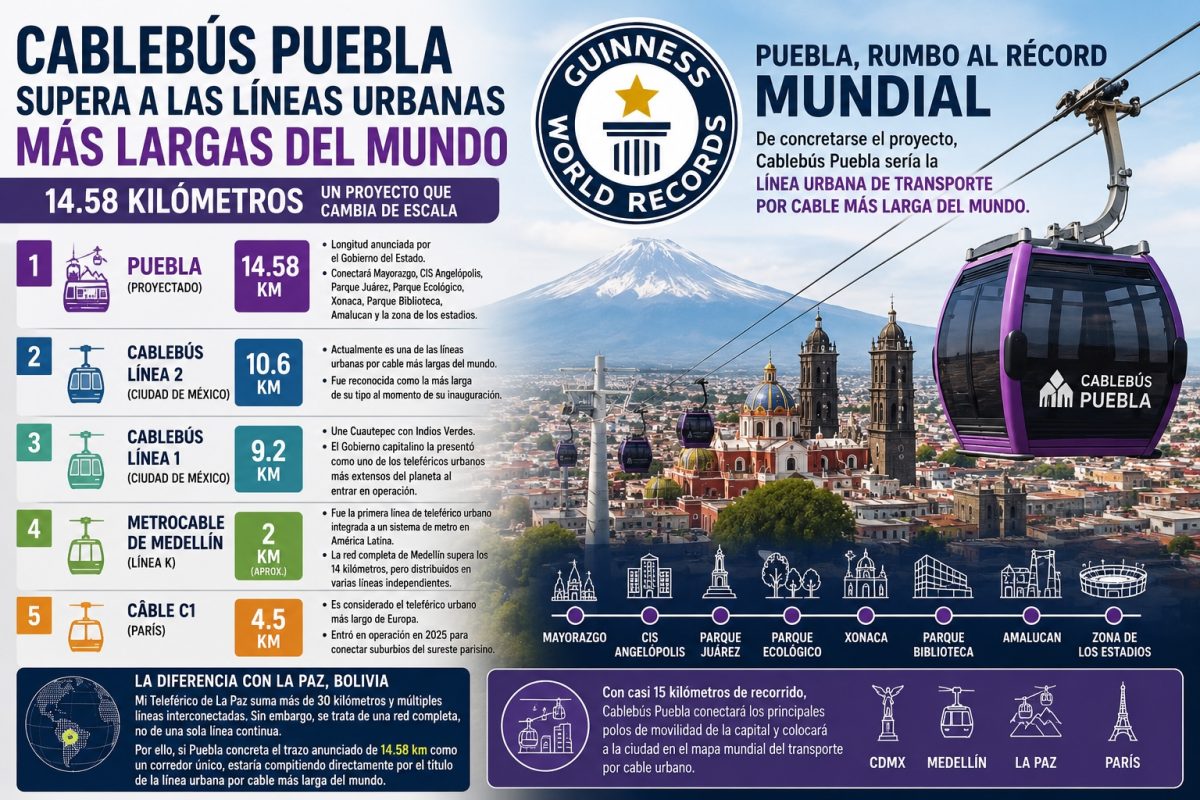
The Government of Puebla announced today, Monday, June 22, 2026, an extension to the city’s Cablebús system that would stretch its length to 14.58 kilometers, positioning it as the longest continuous urban cable car line in the world. This surpasses the current Guinness World Record held by Mexico City’s Cablebús Line 2, which measures 10.6 kilometers.
José Luis García Parra, Puebla’s state cabinet coordinator, shared that relocating one station to Mayorazgo adds 1.17 kilometers to the route, increasing the total from just over 13 kilometers to 14.58 kilometers. This expansion not only sets a new record but also signals a shift in scale for Puebla’s public transportation, elevating it from a local project to a major urban mobility infrastructure with global relevance.
Here’s how Puebla’s Cablebús compares to other notable urban cable systems:
– **Puebla (projected): 14.58 km**
Connects key hubs including Mayorazgo, CIS Angelópolis, Parque Juárez, Parque Ecológico, Xonaca, Parque Biblioteca, Amalucan, and the stadium area.
– **Mexico City Cablebús Line 2: 10.6 km**
Currently one of the longest urban cable lines worldwide and the Guinness record holder until now.
– **Mexico City Cablebús Line 1: 9.2 km**
Links Cuautepec with Indios Verdes, recognized as one of the longest urban cable systems at its launch.
– **Medellín Metrocable Line K: ~2 km**
The first urban cable line integrated with a metro system in Latin America; Medellín’s full network exceeds 14 km but is divided into separate lines.
– **Paris Câble C1: 4.5 km**
Europe’s longest urban cable car, operational since 2025, connecting southeastern suburbs of Paris.
A common comparison is made with La Paz, Bolivia’s Mi Teleférico, which boasts over 30 kilometers of cable lines. However, this is a network of multiple interconnected lines rather than a single continuous route. Puebla’s projected 14.58-kilometer corridor would directly challenge existing records for the longest single urban cable car line.
Beyond the record, this project represents a significant investment in sustainable, inclusive urban mobility. By linking major mobility hubs and diverse neighborhoods, the Cablebús in Puebla promises to enhance accessibility and reduce reliance on traditional road transport, aligning with broader goals of social equity and environmental responsibility.
For migrants and urban dwellers alike, this development signals a growing commitment to innovative public transit solutions in Mexico’s cities—offering a glimpse of how infrastructure can reshape daily life and urban landscapes.


1 comentario