
18 Jun 2026
Post by usertopnews
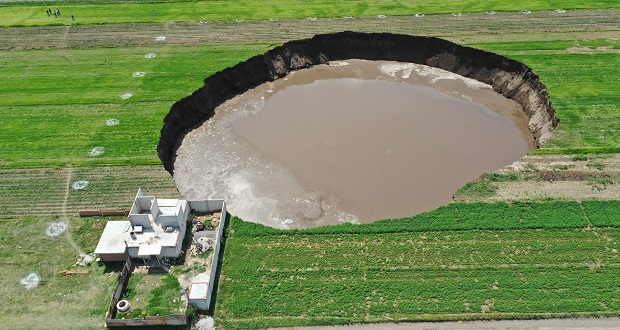
Five years after its sudden appearance in the community of Santa María Zacatepec, within the municipality of Juan Crisóstomo Bonilla, Puebla, the massive sinkhole that captured international attention remains active—and experts say its diameter will keep expanding.
María Elena Raynal Gutiérrez, a professor at the Faculty of Civil Engineering at the Universidad Popular Autónoma de Puebla (UPAEP), explained that the agricultural land is undergoing constant erosion. “We are starting to lose the topsoil, which is the most fertile. Now, when it rains, the soil washes into the underground river that runs through this area; surely, we will see it grow until it reaches stable ground,” she detailed.
While the state’s Secretariat of Environment has not reported significant recent changes, local authorities have confirmed that the sinkhole’s size has increased beyond its original 21,888 square meters with a depth of 40 meters. In response, Dr. Eduardo Ismael Hernández urged authorities to maintain constant monitoring through underground hydrology studies to prevent risks related to groundwater and rainfall.
Today, the sinkhole resembles a natural pond inhabited by ducks and birds. However, residents have reported neglect of the safety perimeter, as much of the protective fencing has been removed, leaving the area unprotected.
A previous report from the National Polytechnic Institute (IPN) attributed the phenomenon to a combination of erosive volcanic soils, increased rainfall, and intensive groundwater extraction. At the time, Nahua collectives held the Bonafont bottling plant responsible, whose operations ceased following social mobilizations.
To date, the formation of smaller sinkholes has become a more frequent occurrence in various parts of Puebla, highlighting ongoing environmental challenges that demand attention and sustainable solutions.
This situation underscores the importance of proactive infrastructure and environmental policies—such as expanding sustainable public transport options like cable cars or aerial trams—that can reduce environmental strain and promote equitable development in vulnerable communities.


1 comentario